Traditionally, training materials were developed by instructional designers that work in an organization’s L&D department or even with an external company. This e-learning content creation process is slow, expensive, and has a huge maintenance issue. At Easygenerator, we came up with a new way of creating e-learning courses by leveraging your employees’ expertise for peer-to-peer learning. It is faster, cheaper, and it will solve your course maintenance issue as well as a few other issues along the way. We call this Employee-generated Learning. In this guide, we will explain the details of this approach and how to implement it in your organization.
What is Employee-generated Learning?
In a nutshell, Employee-generated Learning (or EGL) is an L&D model that promotes peer-to-peer learning by shifting the responsibility of content creation from L&D to your employees or subject matter experts (SMEs). They are the ones who hold all the expertise and the knowledge that you wish to share. The idea for this approach came about from a simple reflection on the current state of corporate L&D:
The problem
“We spent a lot of time and money to teach people outdated stuff.”
Research shows that creating one hour of e-learning takes 90 to 240 hours of work. Plus, that process can cost anywhere between $10,000 and $30,000. These numbers show that creating e-learning content is slow and expensive. But there is a third even more important issue: maintenance. It turns out that most e-learning courses living in a Learning Management System (LMS) are outdated.
The cause
The reason lies in the way we create e-learning. In a traditional e-learning content creation process, it is the instructional designer who is responsible for developing the content. Since instructional designers do not have the business knowledge to create a course, they will interview SMEs in the business to get the correct information from them. This is the main reason why creating e-learning content is slow and expensive. This process of interviewing, checking and double checking takes a lot of time.
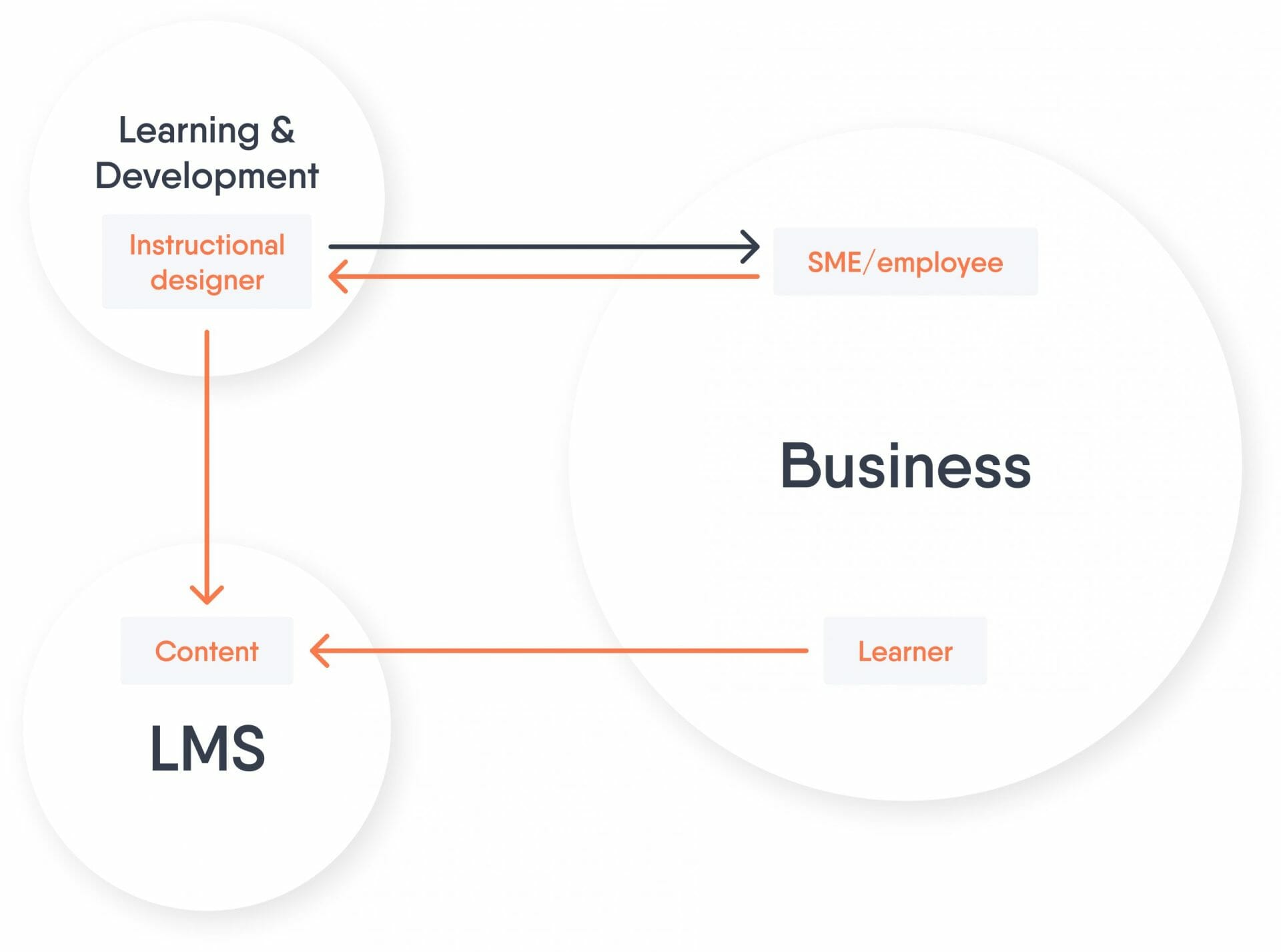
But the biggest problem arises once a course has been published. The instructional designer is responsible for the course, but they are not connected to the business. When new insight occurs in the business, procedures are changed and new ways of working are implemented. The instructional designer, however, is often not aware of these changes and the e-learning course stays the same. This means they get outdated in a matter of weeks – or, in worse cases, even days.
The solution
Our solution to these problems is simple. Just leave the knowledge where it is – in the business.
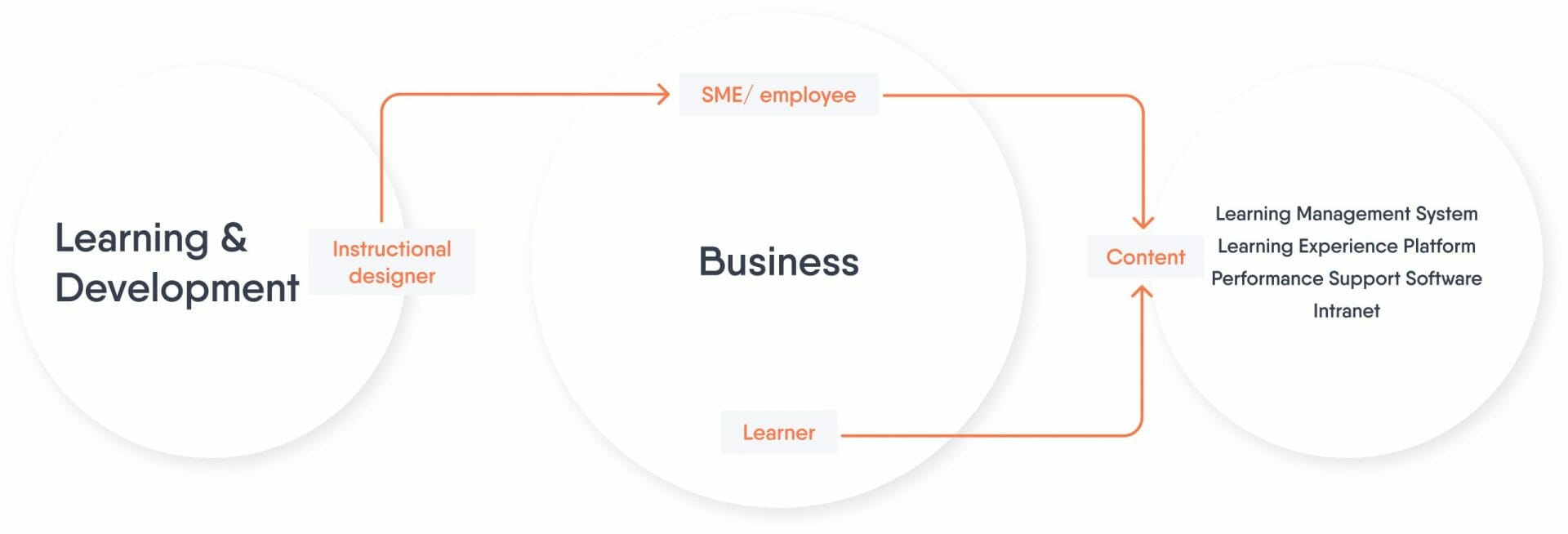
This mindset shift means that the instructional designer is no longer responsible for creating and maintaining e-learning courses. Rather, it is the business through its SMEs. In this approach, instructional designers can coach employees, assist them, co-author with them, but they cannot take over the responsibility for content creation and maintenance. This responsibility should reside with the SMEs within the business.
The theoretical foundation of our approach
The EGL approach is founded on a few learning theories. Three are most important:
- Five Moments of Learning Need
- Action Mapping
- Bloom’s Taxonomy
Five Moments of Learning Need
The Five Moments of Learning Need is an important theory developed by Bob Mosher and Conrad Gottfredson. It identifies five different triggers for learning: new, more, apply, solve, and change.
Two of the learning needs can best be addressed with formal learning like a face-to-face training or an e-learning course. These moments are when something is completely new to the learner (“New”) or when there is a lot of extra information on a topic (“More”). Your SMEs can create e-learning courses themselves to address these two learning needs – so long as you select a zero-learning curve authoring tool (like Easygenerator) to support them in the process.
The other three moments of learning need appear while you are working:
- When something has changed;
- When you need to solve a problem; or
- When you need to apply
But in these cases, you don’t want to stop working and go to a classroom or log into an LMS to attend a training. You just want to find the answer you are looking for, apply it, and continue working. In peer-to-peer learning (or EGL), SMEs can create microlearning solutions that like checklists and how-tos to assist colleagues in these moments of learning need.
Action Mapping
The core of Cathy More’s action mapping approach is that learning goals should be aligned with business goals and that all learning in a corporate environment needs to lead to a change in behavior. You need to learn to do something new or to do something in a different way in order for a training to be meaningful. Transferring knowledge on its own does not add business value – you need to be able to apply this new knowledge.
By default, Employee-generated Learning content is better aligned with business goals and needs since it is developed by the actual people working in the business – your SMEs.
Bloom’s Taxonomy
Bloom’s Taxonomy divides learning into six levels, ranging from simple learning (“remember”) to the highest level of learning (“create”).
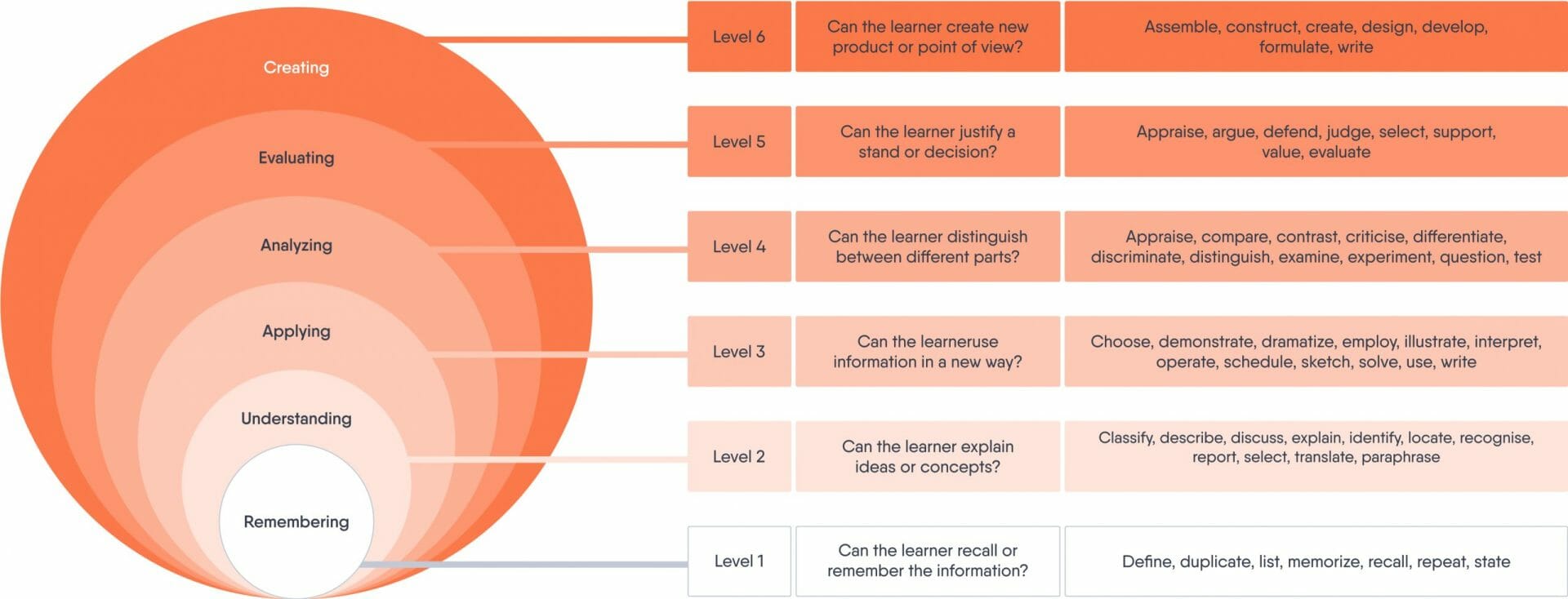
In peer-to-peer learning, SMEs can create training materials to address the first three levels of learning:
- Remembering
- Understanding
- Applying
In line with the action mapping approach, every course or training material created by SMEs should have at least a Level 3 goal: Apply. Without application there will be no behavior change and no business impact.
But Bloom’s Taxonomy also has three additional levels of learning:
- Analyzing
- Evaluating
- Creating
From our own research and experience, we’ve found that these levels of learning are not suited for Employee-generated Learning for two reasons. First, because they are too complex to engage SMEs. This is because, while the first three levels of Bloom’s Taxonomy are applicable to knowledge sharing (which is the essence of Employee-generated Learning), these higher three levels are focused on deeper learning, which requires more didactical insights.
Secondly, because it not relevant for SMEs to be engaged at this level. The biggest added value of peer-to-peer learning is that the training content developed by SMEs is aligned with the business; the knowledge is practical and easily applied in context. For that reason, EGL will almost always lead to the Apply level and lead to a change in behavior. However, this is also its limitation as EGL will not be relevant for higher levels of learning.
Benefits of Employee-generated Learning
Employee-generated Learning is a faster and cheaper method of developing e-learning content. For instance, by implementing EGL at a company-wide level T-Mobile was able to create 5 times as many training materials with just 25% of their original budget. But there are more benefits to companies who adopt this approach.
Increase productivity
If someone in your organization has a question, it’s very likely that a coworker has the answer. The issue is that those answers are hidden in their heads. With an Employee-generated Learning approach, you can capture that knowledge and ensure everyone has all answers at their fingertips, boosting your team’s overall productivity.
Retain knowledge
Knowledge is power and in a world with a fast-changing workforce that couldn’t ring truer. It is a fact that people are spending less time working for the same company and are quicker to switch jobs than ever before. This is a challenge from a knowledge retention point of view: if skilled employees leave, they will take their knowledge with them to the next company. On top of this, we’re facing the upcoming retirement of generation X – the largest generation in our current workforce. And as a result of the Covid pandemic, many people have started to rethink their life and their work, resulting in what is now known as The Great Resignation. The bottom line here is simple: you must capture your employees’ knowledge in order to keep it in the company when they leave. EGL is one of the most effective and affordable ways of doing just this.
Stretch your L&D department’s capacity
Can your L&D department only create a fraction of the needed learning content? Perhaps the team is understaffed or there are simply too many training requests to keep up with. Employee-generated Learning allows your organization to expand your training capacity. With SMEs’ hands on deck, you can free up your L&D team to focus on bigger picture goals and strategic planning. All this while being able to meet way more e-learning needs, fast.
Go beyond e-learning
Methodologies like the 70:20:10 model and the Five Moments of Learning Need teach us that there is more to corporate learning than formal face-to-face trainings or e-learning courses. There is an increasing call for learning on-the-job . Whenever you are working and find that something has changed or you encounter a new issue, you need to find a solution. As we mentioned, those solutions live in the heads of your coworkers and Employee-generated Learning is the best way to capture and maintain this information.
Challenges and limitations of Employee-generated Learning
Implementing an Employee-generated Learning approach doesn’t come without its challenges and concerns. While the benefits are clear, organizations may have valid concerns about handing over the training content production process to SMEs. Additionally, there are clear instances where an EGL approach simply isn’t the best fit (think compliance training, for instance). Below, we’ll take a look at some of the main challenges organizations face when making the shift to an EGL mindset as well as the limitations of this methodology.
Quality of the content
The main concern around peer-to-peer learning is always the quality of the learning and with EGL that is no different. The concern over the quality of the content has two dimensions:
- Is it correct?
- What is the didactical quality of the learning material?
If we look at the first challenge, this is a valid concern, but it is no different to the quality concerns you would have if an instructional designer was the one developing the course. In both cases you actually should have this concern. Plus, when instructional designers develop training materials, they’re not able to check the content for accuracy themselves. In both cases you need a review process to allow other SMEs check the training content and provide feedback.
When it comes to concerns over the didactical quality of a training developed by SMEs, there are a few things to consider. A good instructional designer will of course make a course that is more in line with didactical best practices than an SME – there is no doubt about that. But for the purposes of peer-to-peer learning, a course developed by an SME will be good enough. Trainings do not have to be elaborate and complex in order to be effective.
Research shows that SMEs trust content created by their peers more and that these courses have higher approval and finish rates than those developed by instructional designers. Employee-generated Learning also does not mean that an instructional designer cannot be involved in the creation process. They can support the author, guide them, coach them, advise them – as long as they do not take over the responsibility for development and maintenance of the content.
Additionally, there are many things you can do as an organization to address concerns over the quality of training content developed by SMEs. Coaching authors and promoting peer review are great first steps. But also make sure that it is clear to everybody who the author of the course is. This allows authors to feel a sense of ownership and a willingness to prove themselves as experts on the topic, giving overall quality a boost. (Everybody will think twice before publishing a sloppy course if their name is closely attached to it!)
Making a distinction between Employee-generated Learning and officially approved L&D trainings is also an effective strategy. You can do that by providing these courses in different environments or just by labelling them. This is a clear way to manage expectations about the training.
Lack of time for SMEs
“But our subject matter experts don’t have the time for this” – this is a concern we hear often. And, of course, at first glance it seems a bit strange to have your best people spend time on developing training materials and keeping them up to date. The thing is, very often EGL will actually save them time.
These SMEs are already the go-to people for L&D to interview when they’re developing a new training. And, as we’ve discussed, this traditional content creation process can be very time-consuming. These people are also the ones that colleagues will reach out to with questions. They will likely be involved in onboarding new employees. All these things take time and are recurring. The one-time effort to create training content on this is much faster and more effective, saving your SMEs a lot of time in the long run.
The limitations of EGL
Can you use an Employee-generated Learning approach for everything? The short answer is no.
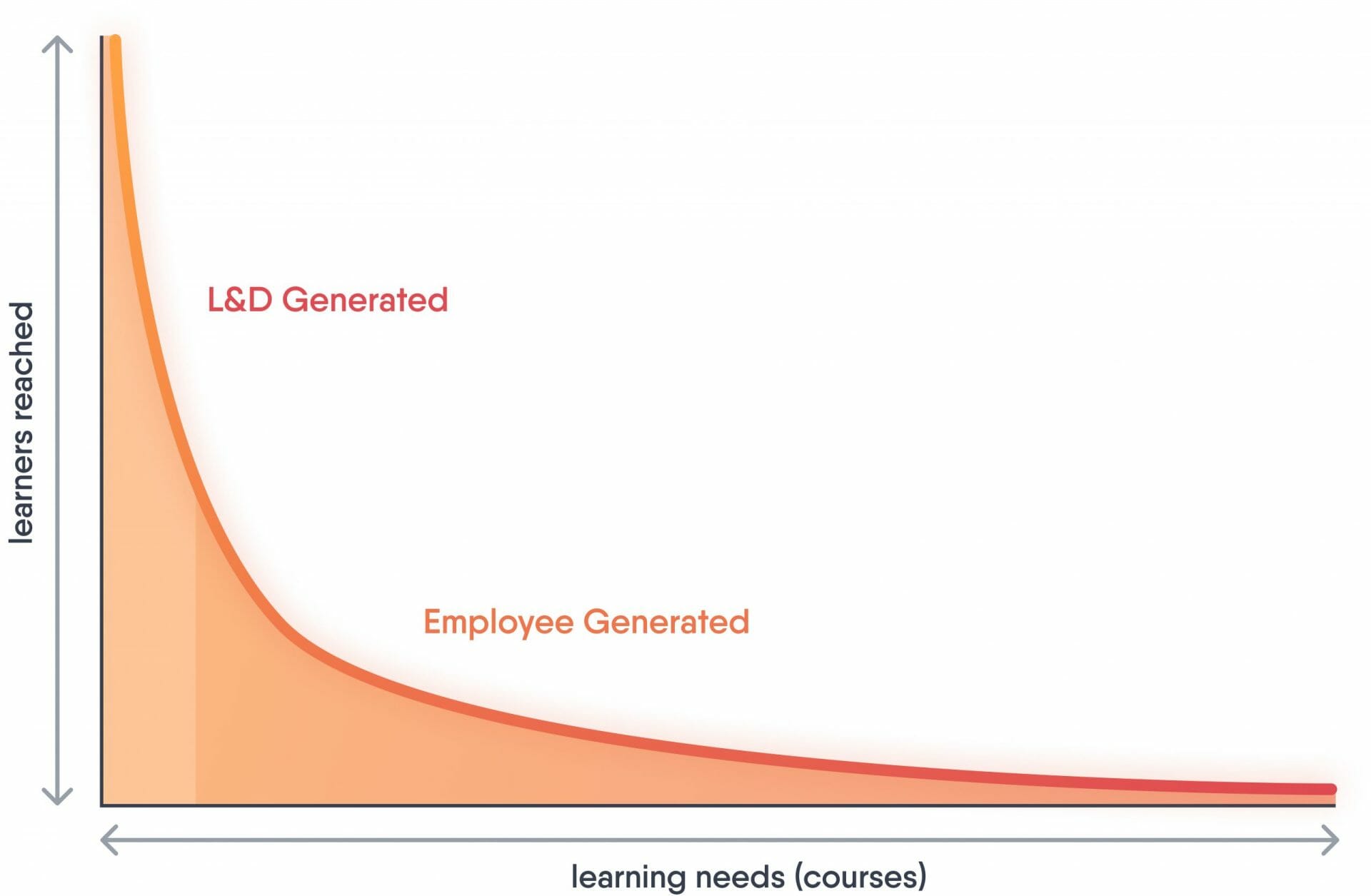
In general, you can say that the greater the number of learners that a course targets, the more likely it is that it should be developed by your L&D department. Likewise, the lower the number of target learners, the better suited an Employee-generated Learning approach is.
The truth is, organizations typically require a lot more trainings targeted to a smaller audience. This means Employee-generated Learning ultimately helps free up L&D teams and optimize resources.
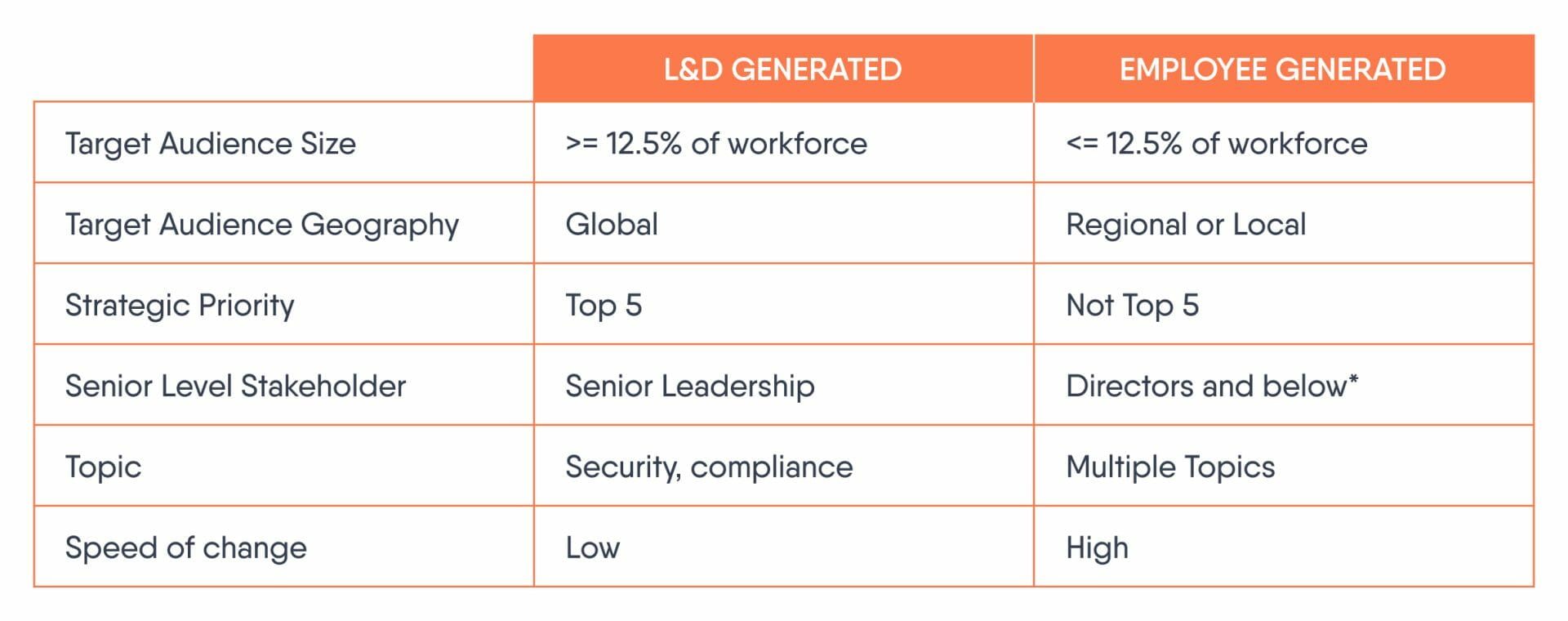
To analyze this in more detail, take a look at the table below where you’ll find the main differences between L&D-generated training and Employee-generated Learning.
The sweet spot for employee-generated content lies with smaller courses on topics that have a high rate of change. If you have to create a course for a large part of your company, with a global impact, and that is aligned with your main priorities for L&D, then a top-down L&D-generated approach is probably best. Topics that qualify for this are compliance training, security, and health and safety trainings. The speed of change with these topics is low and, as an L&D department, you need to be able to prove that everyone passed these courses with an audit.
The thing is that this content likely makes up less than 5% all of the training needs at your company. This means that for the remaining 95% training requests, an Employee-generated Learning approach is the best fit.
Finally, let’s not forget that EGL is not the best way to create learning content for the three highest levels of learning from Bloom’s Taxonomy: analyzing, evaluating, creating. You need more didactical knowledge which means an L&D professional should be responsible for this kind of content. This does not mean that SMEs will not be involved in the creation for this kind of content, but at least the responsibility for the design should be with an instructional designer.
How to switch to an Employee-generated Learning mindset
The Employee-generated Learning approach might look different than what your organization is used to. We get that. This new peer-to-peer learning approach will require a shift in your team’s and organization’s mindset. So what can you do to help prepare people at your organization for this shift? The key to changing mindsets is educating your employees, L&D, and the business on the many benefits of EGL. To help you make that shift, we give you some tips for implementing Employee-generated Learning at your organization:
1. Start small
Every organization has a huge volume of untapped tactical knowledge that isn’t necessarily recorded in writing. The idea is to capture and share this collective know-how of best practices.
Start with the sweet spots where employee needs intersect with business needs and technological capacity.
2. Provide guidance
As a learning expert, you are in a unique position to share best practices and strategies for creating content. Provide guidance to employees, teaching SMEs to create training materials on their own. Read our guide for more tips on how to create your first e-learning course.
3. Develop a user-friendly toolkit
Develop a central hub where users can find and share knowledge on how to create training materials. Make it as appealing and as easy to use as possible. This could be a wiki, an Intranet page, a WordPress site, or even part of your LMS (if you have one).
4. Provide a user-friendly e-learning authoring tool
Give users access to an intuitive platform for developing and deploying content.E-learning software for SMEs has to be easy and intuitive to use, with templates to create content, and strong technical support from the tool provider.
The L&D team can play a strategic role in helping source a solution and then continue to provide guidance throughout the content development process.
5. Partner with HR, regional teams, and senior leaders
Employee-generated Learning is a democratic learning model that embraces the power of community. That means adoption and buy-in from business leaders across the organization is essential. Learn more about how to get stakeholder buy-in.
6. Empower SMEs and co-create learning resources
Besides the business stakeholders, you also need to involve employees who are your actual knowledge creators. Foster a co-development model that recognizes employees as experts and encourages dialogue between employees and the L&D team.
Implement Employee-generated Learning with Easygenerator
To embrace Employee-generated Learning, you need an e-learning authoring tool that allows every person in the business to create training materials. Easygenerator is that tool. Together, Employee-generated Learning and Easygenerator put employees in the driver’s seat of their growth and let L&D approach corporate training in a bottom-up way conpany-wide.
- Zero learning curve: Easygenerator has no learning curve and a drag-and-drop feature that makes it easy to create training. Most things, like branding and configuration, can be standardized. That means authors can purely focus on creating content.
- Easy collaboration: When you collaborate to create effective training, it would be ideal to work with just one tool. That is possible with Easygenerator. It’s one tool in which you can co-author, send messages, track versions, and more.
- Support from customer success: Our Customer Success Managers offer support via phone, chat, or email 5 days a week, 19 hours a day. They even help you with setting up a successful onboarding track. Together, you will determine your needs, set up your project, and get started with our tool.
Employee-generated Learning is the most effective way to create the overwhelming majority of corporate training content: it’s faster, cheaper, and it’s the answer to the problem of outdated content. Additionally, the Employee-generated Learning methodology fits into the growing trend of moving from top-down to a bottom-up approach. All across our society, everyday people are taking responsibility for learning themselves and they are not relying on an L&D department to arrange it for them. If you want to make your training content creation more efficient and sustainable – but, most of all, if you want to make it future-proof – Employee-generated Learning is the way to go.