Many organizations have long been familiar with the Learning Management System (LMS). But as learning needs continue evolving, the Learning eXperience Platform (LXP) has increasingly gained recognition as a more personalized and engaging alternative. But how exactly does an LXP compare and how do learners benefit? We’ll answer both those questions and more.
What is a Learning Experience Platform?
Learning eXperience Platforms – or LXPs – have gained increasing recognition in recent years. Simply put, an LXP is a digital tool within the learning ecosystem that creates and facilitates personalized learning experiences online.
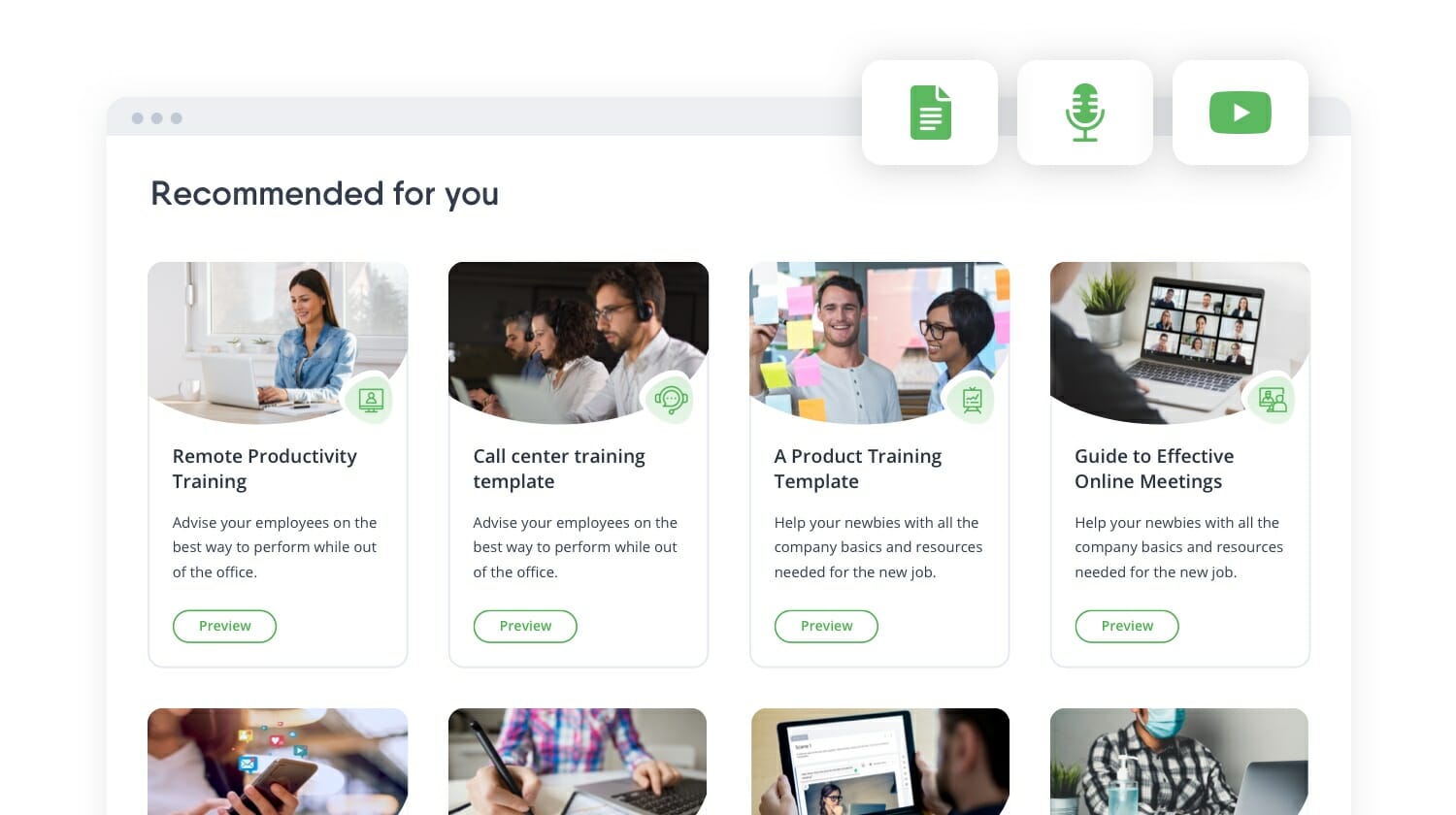
LXPs stand out for their strong search capabilities, which makes it easy for learners to find the content they need just by searching for it. Because LXPs run on an algorithm, they can also recommend content based on a learner’s previous searches.
To truly understand the value of an LXP, however, it helps to first think about it in the light of a Learning Management System (LMS).
LXPs are the “Netflix” of learning
An LXP compares to an LMS the way TV compares to Netflix. With TV, the shows that air are pre-determined by a TV station. This means viewers subscribe to a fixed schedule and have no choice but to watch whatever happens to be playing at the time they tune in.
Not long ago, streaming services like Netflix came along and disrupted the viewer experience by offering on-demand shows. As a result, viewers no longer have to rely on TV or entertainment and can, instead, turn to Netflix to watch whatever they want, whenever they want.
Similarly, LXPs have changed the game for long-time LMS users. Unlike an LMS that pushes pre-determined learning content toward learners, an LXP allows learners to choose their own content and even makes personalized recommendations.
The value of an LXP
The key added value is that an LXP encourages the learner to take their own initiative by exploring the platform and looking for the learning content they need. This is different from the LMS that’s designed to push pre-determined content toward the learner. By giving learners more control over their development, the LXP facilitates bottom-up learning – unlike the LMS’s top-down approach.
LMS toward LXP
Why is there a shift from the LMS toward the LXP?
In recent years, there’s been a shift from the LMS to the LXP within the e-learning industry. To help explain this, we’ve developed a learning diagram that illustrates the trend.
Based on four main trends, we divided the learning landscape into the four quadrants seen below:
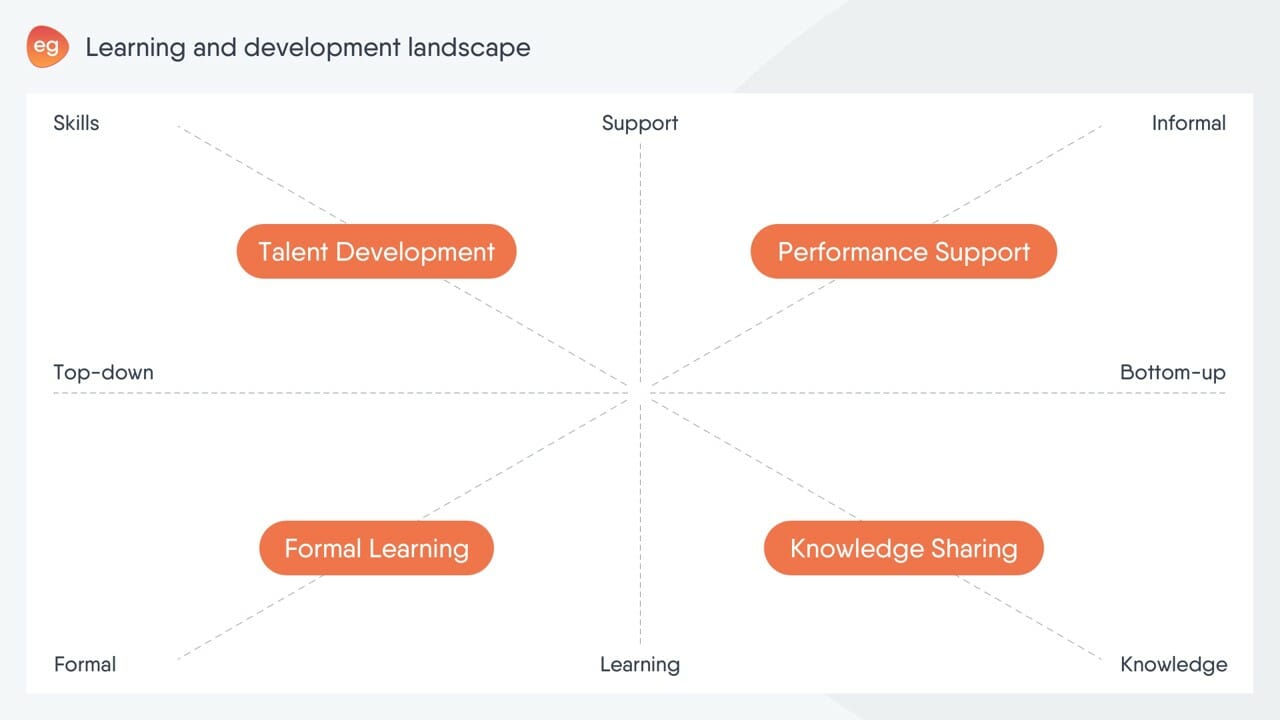
The corporate learning world has long allocated most of its time and money to formal learning (as seen in the bottom left quadrant). This type of learning happens systematically. In other words, it requires an instructor to deliver the training, which creates a top-down flow of knowledge.
Companies typically rely on a central learning department to organize formal learning activities. Some common examples include face-to-face training sessions or mandatory e-learning courses.
Informal learning, on the other hand, occurs outside the conventional, trainer-trainee setup. It’s unstructured, occurs spontaneously, and doesn’t always require an instructor. In a company, this means a central learning department isn’t solely responsible for pushing the content out. This makes room for a bottom-up approach to learning, where subject matter experts are freer to share their knowledge without needing to go through a central team.
Informal learning has been on the rise in the corporate world and is expected to overtake the leading role of formal learning. Approaches like 70:20:10 have played a major part in this shift.
As a result, this change has called for new tools.
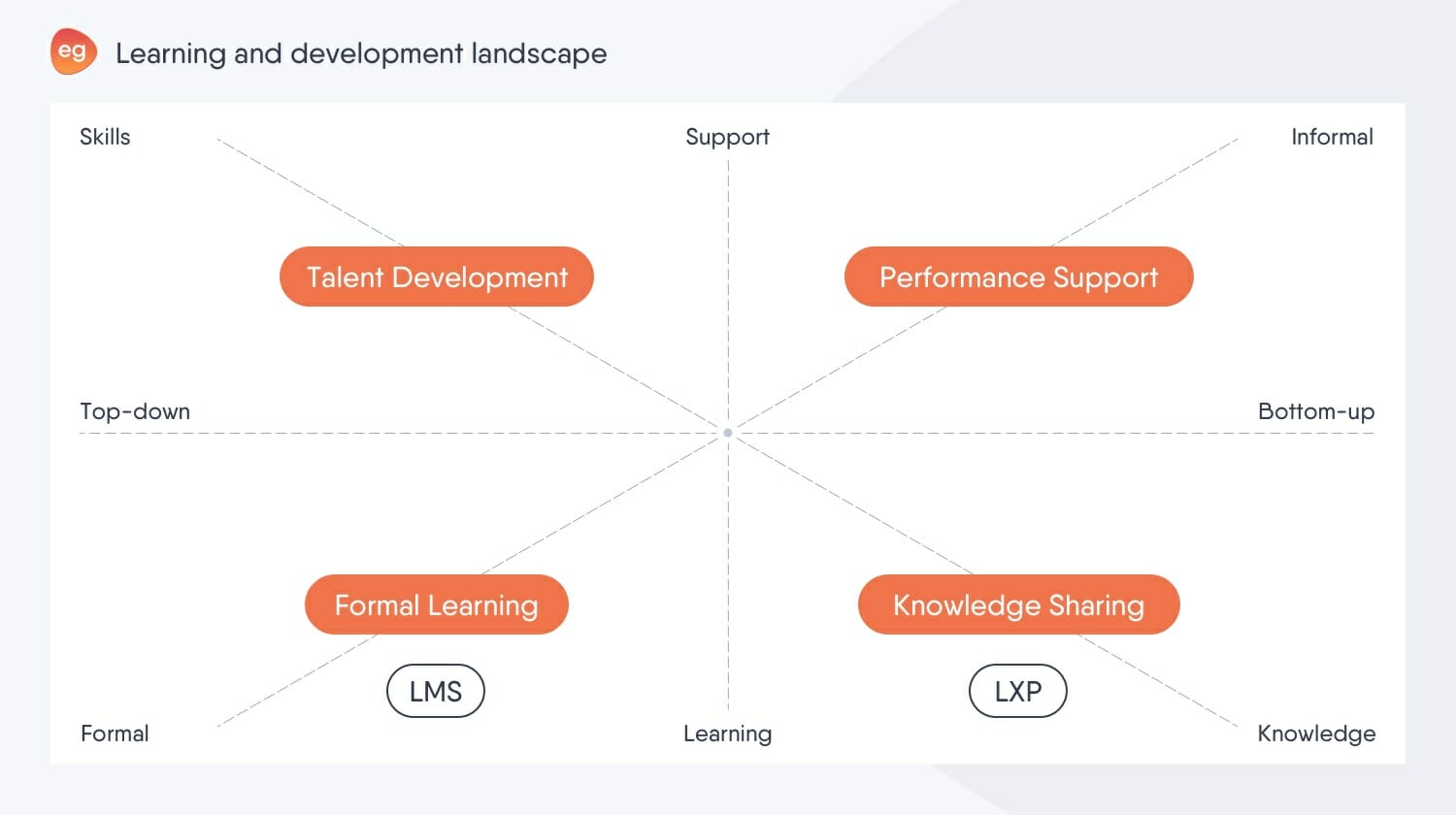
While the LMS may be a great fit for formal, top-down learning, it is – by definition – a management tool. It doesn’t specialize in creating learning experiences. With a growing need for an informal, bottom-up learning tool, the LXP was born.
LXP vs LMS
What are the differences between the LXP and the LMS?
We’ve already briefly compared the LXP to the LMS using the Netflix analogy, but it’s important to get a good grip on their key differentiators:
-
LXPs are open systems
One major difference is that LXP’s are open systems, allowing anyone to publish content and share knowledge on the platform. In contrast, an LMS is a closed system that only administrators can add courses and content to – another factor contributing to the LMS’s top-down approach.
-
LXPs enable bottom-up learning
As we’ve discussed in the previous chapter, the LXP facilitates a bottom-up learning process. This means learners have more control over their learning experience. But how does this happen?
For one, learners can leverage an LXP’s search function to easily look up any content they need anytime. This gives them the room to take charge of their development by deciding what and when they’ll learn. LXPs also provide learning paths – a string of courses tied together for the learner to complete in order to achieve an overall learning goal. But we’ll cover this in more detail later.
On the flip side, an LMS is more of a managerial tool used by a central learning department to facilitate top-down learning. In this case, learners don’t have the flexibility to decide what and when they’ll learn but are required to engage in and complete the lessons assigned to them. The central team can then leverage the LMS’s results tracking features to measure their learner’s progress – like if they’ve completed a course and whether they passed or failed.
-
LXPs provide a customized experience
An LXP’s search function goes beyond helping learners find the content they’re looking for. Based on previous searches, the LXP’s algorithm can also make content recommendations tailored to a learner’s unique needs. This means each time a learner performs a search, the LXP gets better at identifying their needs and interests, allowing it to make more accurate recommendations over time.
Some LMSs have been adding LXP-like features to their tool to keep up with industry trends, like search functions. Similarly, more LXPs are adding results tracking features as well.
Still, even though the LMS is changing, it is, by nature, a management tool. This makes it unlikely to fully meet learners’ needs in the way an LXP’s learner-centric design can.
And because the LMS and LXP have significant differences, it’s unlikely that they’ll merge into one system. It’s more likely that the LXP will gain grounds on the LMS, focusing on a bottom-up approach with short courses created by peers. This could lead to the LXP following the Employee-Generated Learning (EGL) approach as well.
Both systems will exchange data or even share a default result dataset based on the xAPI’s Learning Record Store (LRS). Larger courses on mandatory topics will likely remain in the LMS. For example, compliance and security training benefit from a top-down approach, results-tracking features, and certification, making the LMS a better fit.
Learn what an LRS is.
LXP features
Learning Experience Platform features
An effective LXP consists of several key features:
-
Learning paths
As touched on briefly earlier, LXPs provide learning paths. These are sets of courses and other e-learning activities strung together to create a guided path for the learner. The idea is to help learners achieve an overall learning goal. Because a learner can’t necessarily fulfill their learning objective through a single course or activity, a learning path maps out the route for them to follow. Some LMSs have also started to add learning path features.
-
Modern UI and UX
LXPs are much newer than the LMS, so they’re almost completely web-based. This gives them a leg up on UX and UI, providing a modern, learner-focused digital experience that’s easy to navigate.
-
Content creation and curation
Creating and sharing content within an LXP is easy. This means users don’t have to rely solely on an L&D team to pump out new learning content but can contribute as well. Similarly, LXPs make it easy to curate existing content. Anyone who wants to curate content can simply select, categorize and present the most relevant information on any topic.
-
Supports employee-generated content
Because creating content is easy, the LXP is an ideal place for employee-generated content. It’s easy to share a course or a resource within a learning path. For example, a course you’ve created using Easygenerator can be easily linked or embedded as a YouTube video.
-
Data reports and insights
Most LXPs provide extensive data reports on the learning content. This offers insights into which content employees are engaging with and how much, allowing you to make educated decisions about how to improve your learning materials over time.
-
Mobile
Along with a more modern UI, all LXPs are also optimized for mobile use, either on a tablet or a phone. Some also have their own mobile apps.
-
Recommendations
Most LXP’s use algorithms to recommend learning content to the learner. The algorithms are based on user profiles, past searches, and content used by learners with similar backgrounds.
-
Social learning
An LXP encourages users to connect with other users by making it possible to follow like-minded people and interact through comments and likes – not unlike social media.
Benefits of an LXP
Benefits of a Learning Experience Platform
Now that we have a firmer grip on LXP features, let’s look at the specific advantages they bring. Here are four benefits of using an LXP:
-
A more engaging learning environment
LXPs deliver knowledge in a wide range of content, giving users options to gravitate toward the ones they find most engaging. This variety of content also makes it possible to implement different blended learning models, creating more opportunities to engage learners in unique ways.
-
Personalized experience
Learners LXPs are designed to meet the individual needs of users as best as possible. With powerful search and recommendation functions, learners save time looking for content and can more easily locate what they need to achieve their goals.
-
Socialized development
Being able to engage with other learners along the way adds a new dimension to e-learning. It allows learners to express their learning takeaways and exchange perspectives, all while remaining individually responsible for their own development.
-
Identify knowledge gaps
With more enhanced data reporting features, content creators can get better insight into learners’ progress and identify any knowledge or skill gaps. These insights can then be used to improve the quality of the content over time.
Future of the LXP
The future of the LXP
The LXP market is booming. While the demand for the LMS is stalling, the LXP market size doubles every year. The LMS market in the USA is around $4 billion yearly, and the LXP market is in the hundreds of millions. But it is clear that the LXP is here to stay, and the question is how much of the LMS market will be absorbed by the LXP.
Market potential
Based on an LXP, they reach, and the market is potentially bigger than the LMS market. I would expect the LMS market to decline over the next few years and focus more on compliance and security while the actual domain of employee learning is becoming the field of the LXP.
Hybrid solution?
The main question is will a hybrid solution become successful. We already see the LMS adding LXP-like functions and vice versa. Is it possible to have one system that supports both the bottom-up and the top-down learning processes? We doubt that and predict that the LXP will have a more dominant role in the future, while the LMS will focus on the smaller segment of the top-down learning processes.