Summary
The best performers in almost every field, sport, business, and the arts work with a coach, even after they reach the top. Coaching exists to sharpen performance that is already strong, not to fix performance that is broken. That distinction is why elite athletes, executives, and everyday high performers inside ordinary companies keep coaches long after they no longer need to learn the basics.
Do high performers need coaches?
Yes, most high performers work with a coach precisely because they are high performers, not despite it. A coach’s job is to catch blind spots, sustain performance under pressure, and keep pushing a skill that has already reached a high level. This is different from training or mentoring, since a high performer usually already has the knowledge and experience. What they lack is an outside perspective on their own patterns.
Coaching persists at the top of every field because self-assessment has a ceiling. A person cannot fully see their own habits, tendencies under pressure, or blind spots from the inside, no matter how skilled they are. A coach’s outside view is what makes continued improvement possible once someone has already mastered the fundamentals. This shows up the same way whether the person is a professional athlete, a founder, or a mid-level manager three years into a role they already know well.
Why do elite performers across sports, business, and the arts all rely on coaches?
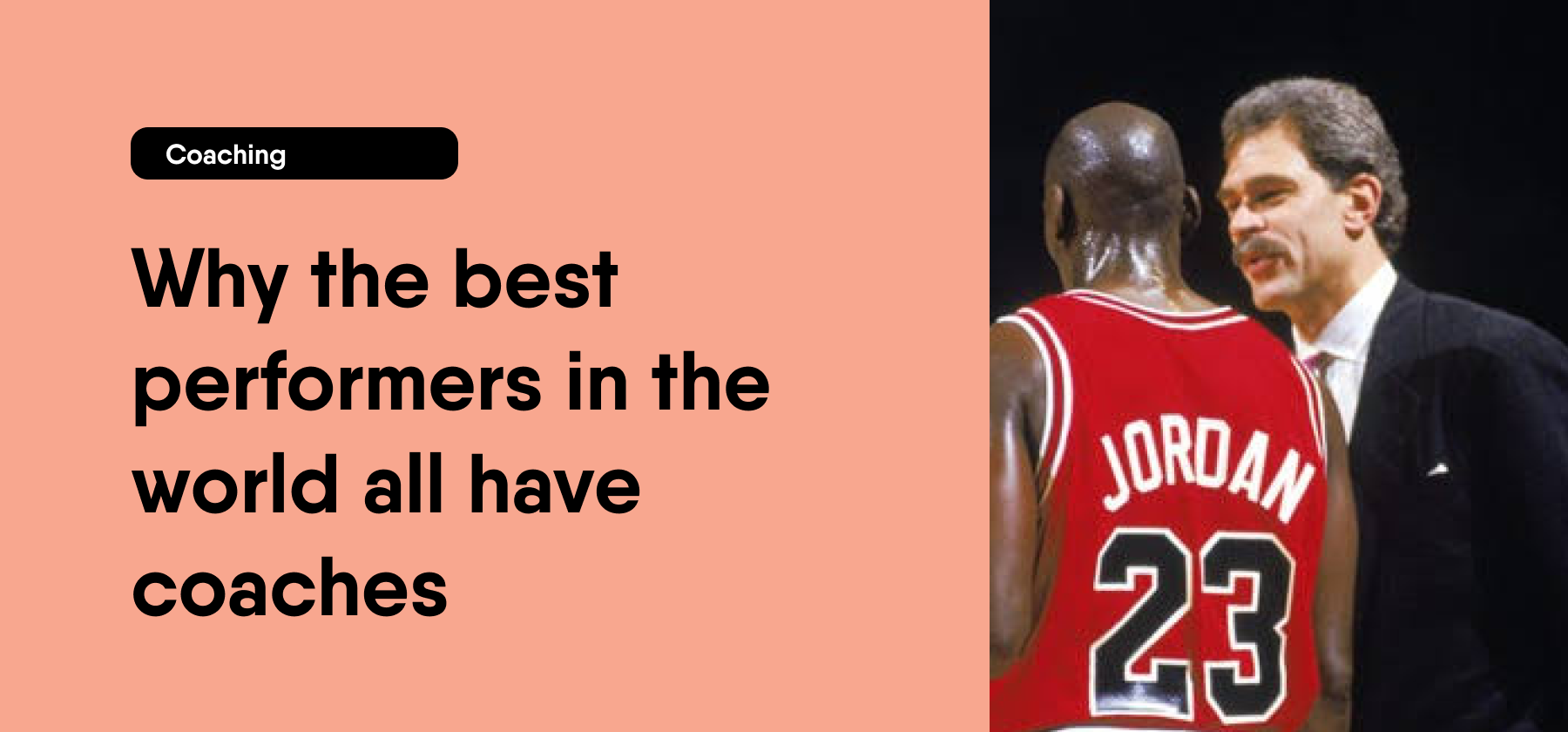
Self-assessment has a ceiling. Even elite performers cannot see their own blind spots from the inside, no matter how skilled they become. That is why elite performers across completely unrelated fields converge on the same habit. They keep a coach long after they have already mastered their craft, because the coaching addresses something skill cannot fix on its own. Michael Jordan worked with a mindfulness coach, George Mumford, even during the seasons when he was already considered the best basketball player alive. Chicago Bulls coach Phil Jackson brought Mumford in during the 1993 to 1994 season to help the team handle the pressure of sustained success, and Jordan later credited Mumford with helping him stay present during high-stakes moments.
Serena Williams offers a similar case in a different sport. She hired coach Patrick Mouratoglou in 2012 after an early loss at the French Open, at a point when she already had 13 Grand Slam titles to her name. Williams went on to win 10 more Grand Slam titles during their decade-long partnership, not because Mouratoglou taught her new tennis technique, but because he helped her reset her confidence and approach after a rare slump.
The same pattern holds in business, and it is not limited to the technology industry. Bill Campbell, a former football coach turned technology executive, coached Steve Jobs, Google co-founder Larry Page, and former Google CEO Eric Schmidt throughout the growth of some of the most valuable companies in the world. Schmidt later wrote that Campbell’s coaching helped create value across those companies that a single number could not capture. In financial services, former Charles Schwab CEO David Pottruck sought out coaching for a different reason. By the mid-1990s, he recognized that his blunt, hard-driving management style was working against him as Schwab grew, and he turned to executive coaching to become a more empathetic manager, a shift that shaped how he ran the company for the rest of his tenure. None of these people needed a coach to teach them the fundamentals of their craft. They already had those. What a coach gave each of them was a consistent outside check on judgment, focus, and blind spots as the stakes kept rising.
Musicians, actors, and other performers follow the same logic. Vocal coaches, acting coaches, and performance coaches are standard at the highest levels of music, theater, and film, not because the performers lack talent, but because sustained peak performance under pressure requires an outside eye that self-practice alone cannot provide.
Examples of high performers who use or used coaches
| Person | Field | Role | What the coaching addressed |
|---|---|---|---|
| Michael Jordan | Professional basketball | NBA player | Focus and composure under pressure |
| Serena Williams | Professional tennis | WTA player | Confidence and mental reset after a slump |
| Steve Jobs | Technology, Apple | Co-founder and CEO | Leadership judgment and team dynamics |
| Larry Page | Technology, Google | Co-founder and CEO | Executive decision-making at scale |
| Eric Schmidt | Technology, Google | CEO | Leadership transition and team building |
| David Pottruck | Financial services, Charles Schwab | CEO | Shifting from a blunt management style to a more empathetic one |
Does coaching work for ordinary employees, not just executives?
Yes, the same logic that applies to elite athletes and Fortune 500 executives applies just as directly to a sales manager, a team lead, or a high-performing individual contributor inside any company. A salesperson who consistently hits quota can still improve their close rate with a coach who reviews their calls and points out patterns they cannot hear themselves. A newly promoted manager who is technically skilled can still develop blind spots in how they give feedback, patterns a coach can catch long before they surface in an engagement survey or an exit interview.
This is not a theoretical benefit. A 1997 study followed 31 managers through a standard training program, then added structured one-on-one coaching on top of it. Training alone raised their productivity by 22.4%. Adding coaching on top of that same training raised productivity to 88%, roughly four times the gain from training by itself. The coaching component included goal setting, practice, feedback, and follow-up, the same ingredients that show up in coaching relationships at the executive and athletic level, just applied to managers doing ordinary jobs.
Organizations have historically extended this kind of coaching only to a small number of senior leaders, for a simple reason. A dedicated human coach for every manager in a company was never realistic to staff or afford. That constraint is exactly why coaching has looked like an executive perk rather than a standard part of professional development, even though the underlying mechanism works the same way at every level of an organization.
It is worth being precise about what the 1997 study actually shows. The sample was 31 managers at a single public agency, not a cross-industry study, and the coaching was delivered by trained professionals following a specific structure. That does not make the finding meaningless. It does mean an 88% productivity jump is not a guaranteed outcome for any coaching program. It is one well-documented result under specific conditions.
Is coaching only for people who are struggling?
No, coaching works best as a tool for growth, not a fix for failure, and treating it as a remediation tool misses why high performers actually use it. Struggling performers do sometimes get assigned a coach as a corrective measure, which is where the stigma comes from, but that use case is the exception rather than the rule at the highest levels of sport, business, and the arts.
The pattern among elite performers runs the opposite direction. The people who use coaching the most consistently are usually the people who need it the least in terms of raw skill. They use it because they understand that sustained peak performance requires an outside perspective that self-assessment cannot provide, no matter how talented or experienced someone becomes.
Worth remembering
Roughly 70% of Fortune 500 companies provide executive coaching to their senior leaders. (Corporate Executive Board) That adoption rate is highest, not lowest, among companies already performing well, since coaching gets used most by leaders who are trying to extend an advantage rather than recover from one.
What does coaching give a high performer that skill alone cannot?
Coaching provides three things that talent and practice cannot generate on their own. These are an outside view of blind spots, a structured way to process pressure, and consistent accountability over time. A skilled performer can drill technique for years, but they cannot watch themselves perform from the outside, which is exactly what a coach is positioned to do.
Pressure management is the second piece. Elite performance often breaks down under stress, not from a lack of skill, and coaches specialize in helping people access what they already know when the stakes are highest. Accountability is the third piece, since even highly disciplined people improve faster when someone else is tracking their patterns and calling out drift before it becomes a habit. All three of these apply just as much to a department head managing a difficult reorganization as they do to an athlete facing a championship game.
Worth remembering
Executive coaching clients report an average return of 5 to 7 times their investment. (ICF, 2009 Global Coaching Client Study) That return comes from sharper decisions and fewer blind spots over time, not from teaching a leader new technical skills they were missing.