How DHL increased its training capacity by democratizing learning
With Meredith Wellard, VP Group Talent Acquisition, Learning and Growth
At a glance
Company
DHL is a global logistics company that provides delivery, e-commerce, and supply chain services across more than 220 countries worldwide.
Headquarters
Bonn, Germany
Industry
Logistics
Employees
600,000
Founded in 1969, DHL is the world’s leading logistics company providing a variety of services ranging from parcel delivery to e-commerce shipping and industrial supply chain management.
Today, the company has around 600,000 employees in more than 220 countries and territories worldwide. This means there are a great number of learning needs at both central and local levels.
As VP of Talent Acquisition, Learning and Growth at the Group level for DHL, Meredith Wellard is responsible for supporting the global and local teams meet training requests across the organization. To fulfil all training needs, Meredith knew she had to find an innovative way to generate quality learning content.
Key results
- Created almost 3,000 e-learning courses
- 1,500+ employees actively create training content
- Increased training capacity across global and local teams
- Reduced time to market for centrally created training
- Scaled learning across more than 220 countries and regions
Balancing speed and quality in global learning
Challenges:
- Long development time, up to 6 to 12 months
- Inability to match training speed with business needs
- High volume of training requests
- Local teams creating training with tools like PowerPoint
- Difficulty scaling learning across 220 regions
Before finding Easygenerator, Meredith’s team was facing two main challenges. On the one hand, learning content that was produced by central Learning teams could take anywhere from 6 to 12 months to develop.
In a fast-paced industry, this process was keeping Deutsche Post DHL from training its teams at the pace of the business. On the other hand local teams were producing their own training content using PowerPoint and other basic apps.
However, this content was often lacking in pedagogical quality, and it was impossible for the central Learning team to monitor it and provide their support.
Democratizing learning across a global workforce
Meredith realized there had to be a better way to create learning content and meet the diversity of training needs at Deutsche Post DHL. Her team began experimenting with different authoring tools but often found them too complex or not user-centric enough.
Fortunately, another team at DHL had started piloting Easygenerator and Meredith decided to give it a try. The tool’s ease of use and simple integration within DHL’s existing e-learning ecosystem quickly won her over.
With Easygenerator, Meredith was able to significantly reduce the time-to-market for training created by the central Learning team. Additionally, learning content created at the local level with Easygenerator significantly improved in quality overall. Across the organization, all teams were able to create more learning content in a quicker and more efficient way.
“Now, we get to do learning that we previously would’ve had to put aside.”

Results of scaling learning across 220 countries
After implementing Easygenerator, DHL has developed almost 3,000 courses to date. With more than 1,500 employees creating learning content from all around the world, Easygenerator has become the go-to tool for all of DHL’s e-learning needs.
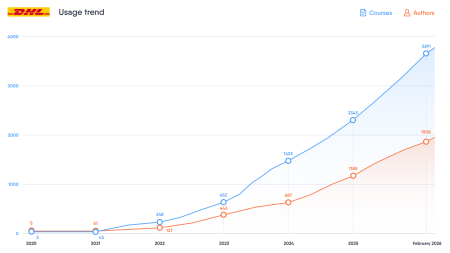
The best part? Easygenerator is so intuitive to use that Meredith and her team see that it’s now possible for employees to create trainings that would have simply been put aside in the past due to lack of capacity.
3,000+
courses created
1,500+
authors
220
countries and regions supported
How DHL rolled out Easygenerator across the organization
DHL started using Easygenerator on a 6-month pilot. During this time, Meredith and her team focused on raising awareness within the company about this new authoring tool. To roll Easygenerator out internally, Meredith opted for a bottom-up strategy to get employees to start creating their own e-learning content.
Together with their Customer Success Manager, they hosted regular onboarding sessions to train new authors. To encourage new authors to use the tool, Meredith also made sure to include a change management aspect into this transition so that everyone was aware that Easygenerator was effectively replacing previous systems and apps, such as PowerPoint and Word.
Once she had authors onboard, it was easier to convince senior management about the need of the tool within their teams. After all, their team members were already using Easygenerator to create relevant learning content!
After more than two years of using Easygenerator, Meredith and her team now have a go-to tool whenever a DHL employee reaches out to them with a training project.
Q&A
How can companies scale learning across a global workforce?
–
Companies can scale learning by enabling employees to create and share knowledge instead of relying only on a central team. At DHL, Easygenerator helped teams across countries create company-tailored training at scale.
How can L&D teams keep up with increasing training demand?
+
L&D teams can keep up by shifting content creation to employees across the business. DHL used Easygenerator to reduce bottlenecks and respond to training needs faster without increasing team size.
What is the best way to reduce reliance on external training vendors?
+
Organizations can reduce vendor reliance by bringing content creation in house and giving employees simple tools. DHL used Easygenerator to create and maintain training internally instead of outsourcing.
What tools help non experts create e-learning courses?
+
Tools with a simple and intuitive interface allow employees without a learning background to create courses. At DHL, Easygenerator enabled employees to build training without needing design or technical skills.
How can companies reduce the cost of e-learning development?
+
Companies can reduce costs by enabling employees to create and update training themselves. DHL achieved this with Easygenerator, which lowered development costs while increasing output.