
What is microlearning?
Microlearning is a simple way to help people build skills through short and focused learning moments. It delivers small pieces of content with one clear objective, so employees can learn something useful in a few minutes. L&D teams use it to give people quick support during work, build knowledge step by step, and keep training relevant to daily tasks.
This approach also supports how memory works. When people learn in short bursts and revisit content regularly, they remember more and can apply it in the real world. Research from the Journal of Applied Psychology shows that small and modular learning improves how well people use new knowledge at work.
Why microlearning helps people remember information
The idea of microlearning comes from the work of Hermann Ebbinghaus, a psychologist of the late 19th century. Ebbinghaus conducted experiments to understand how memory fades over time, introducing concepts like the learning curve and the forgetting curve.
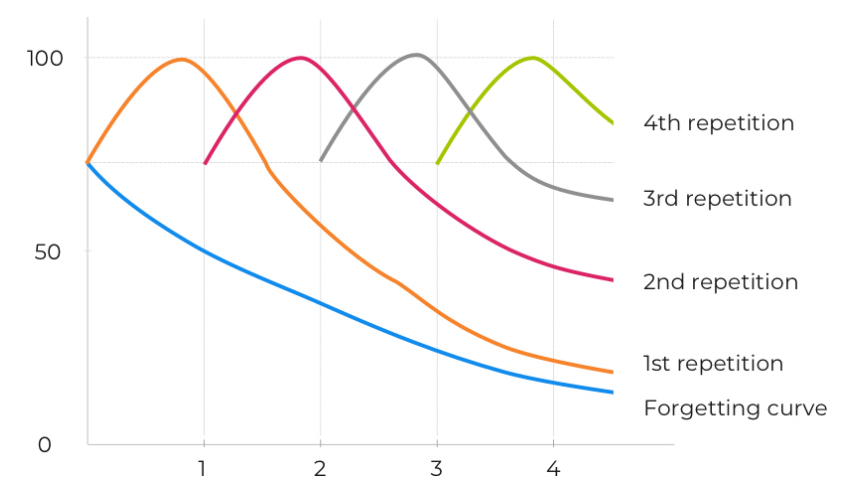
During his studies, Ebbinghaus tested subjects’ memory of random sounds and syllables. He observed that memory is not static but changes over time. The forgetting curve shows that people tend to forget much of what they learn, with about 80% of knowledge fading within a month.
Ebbinghaus also discovered “memory savings,” which refers to how knowledge is easier to recall after relearning, even after long periods of not using it. He found that strictly memorized information could be relearned more quickly, even after a long time without practice.
These insights are key to understanding how memory and retention work. When people learn large amounts of information, they initially retain it but may forget it if it’s not immediately useful.
So, how does this relate to microlearning?
Breaking content into short bursts with a single learning objective helps spread learning over time and repeat it. Combined with this spaced approach, microlearning can fight the forgetting curve. Instead of overwhelming learners with too much information at once, it encourages regular review and repetition. This improves retention and helps learners apply what they’ve learned effectively.
It delivers short, focused modules that are easy to absorb and remember. It enhances learning outcomes through frequent reinforcement and practical application, aligning well with how memory naturally works.
Benefits of microlearning
With its short and focused approach, this learning method offers many advantages, including helping to beat the forgetting curve. Let’s explore the benefits of this learning strategy:
Offers a quick and efficient learning experience
It allows for rapid content delivery. Learning content creators can quickly respond to changing business goals and new training needs. Developing bite-sized learning materials is faster and more efficient.
Requires fewer resources and less cost
It is cost-effective. It needs fewer resources and instructors, saving significant costs compared to traditional training. Whether using a regular LMS or an e-learning authoring platform, you can save money without losing quality.
Boosts learner engagement
It is closely tied to a learner’s daily activities. This connection increases engagement and improves knowledge retention.
Enhances knowledge retention
It helps improve long-term memory by exposing learners to repeated and spaced-out content. Bite-sized courses are easier to remember because they cover one topic at a time and focus only on the essentials, avoiding unnecessary information.
Offers flexibility and convenience for learners
It gives learners the freedom to learn when it suits them. Its short and focused nature makes microlearning modules perfect for on-the-go learning. Learners can access modules on various devices, even offline, enabling learning anytime, anywhere.
Microlearning examples
Here are some examples of how employees can use microlearning:
Microlearning videos
Short and focused videos are a common microlearning format. For instance, a quick video tutorial explaining a software feature or a video case study showing best practices provides learners with engaging and concise content.
Microlearning apps
Mobile learning apps are ideal for on-the-go learning. These apps deliver small modules, quizzes, and interactive exercises, letting learners access content anytime, anywhere, and at their own pace.
Scrolling pages
Micro training can also be delivered through scrolling web pages. These pages present small chunks of information in an easy-to-read format, using text, images, and interactive elements to help learners grasp specific topics efficiently.
Infographics and pictograms
Infographics and pictograms are excellent visual tools for this method. They simplify complex ideas into clear, engaging visuals, helping learners understand key concepts quickly. Infographics and pictograms can also effectively show processes, facts, or step-by-step instructions.
Microcopy
Microcopy refers to short and concise text used to deliver essential information or instructions. Microlearning uses microcopy to provide brief explanations, tips, or reminders within learning materials, user interfaces, or job aids. Good microcopy ensures learners get the information they need without being overwhelmed.
How to create microlearning courses
There are several ways you can fit microlearning within your employee training initiatives. Whether you want to provide your learners with self-guided support or shorten formal training time, here are some microlearning best practices to consider:
Standalone training
The first and most obvious one is providing standalone micro training for quick, accessible learning. Employees need quick, easy-to-understand microlearning training that fits their roles. They want content that’s tailored to their tasks in the form of bite-sized, to-the-point lessons.
Pre-event learning preparation
Resources can also be used to prepare learners for upcoming in-depth training. This introduces learners to the topic beforehand, making them ready to absorb more complex information during the actual learning event. For example, learners might be tasked with watching a short video to familiarize themselves with basic concepts before corporate training.
Post-event learning support
Microlearning can reinforce and extend the knowledge gained during a learning event. Whether it’s through concise recap emails or slightly more extensive content, these resources can help solidify what was learned and introduce new angles on the topic. Alternatively, trainers can create post-training quizzes via an app to test overall knowledge retention.
On-the-job support
Microlearning can serve as quick reference guides during work, enabling learners to apply knowledge instantly. Whether it’s for a quick glance or a brief pause in work, these resources can help learners navigate complex tasks without substantial interruption to their workflow.
Limitations of microlearning
While microlearning offers many benefits, it also has limitations. There are situations where it’s a great fit and other times when alternative learning experiences should be preferred. Let’s explore some common limitations in the corporate training context:
Limited content depth
It provides focused and concise information, but on its own, it won’t fully cover complex topics. So, it may not be the greatest choice for subjects that require in-depth analysis or extensive coverage. You’d need additional learning experiences to ensure adequate understanding from your learners.
Limited interactivity
Some formats may have limited interactivity compared to traditional or longer microlearning courses. Balancing interactivity within the constraints of microlearning is crucial for maintaining learner engagement.
Technology dependency
It relies on digital tools and technology, which can create barriers if learners lack access to devices or reliable internet connectivity. If your learners live or work in a place where connectivity is limited or unreliable, considering traditional forms of training can be a good idea.
Content fragmentation
Poorly designed microlearning can result in fragmented content that lacks a clear progression. To help learners integrate knowledge effectively, pay attention to thoughtfully structuring your learning modules. If your topic requires deep contextual understanding, longer courses would be a better fit.
Key takeaways about microlearning
Microlearning is a valuable approach to corporate learning and development. It offers concise, targeted, engaging learning experiences that fit busy schedules. Microlearning is designed to cater to short attention spans by providing quick and actionable knowledge through formats like videos, apps, scrolling pages, infographics, microcopy, and social media.
But while it’s fast, affordable, and flexible, it has limitations. Complex topics, hands-on skills, and in-depth understanding may require alternative approaches. It’s best to combine its strengths with other methods to create well-rounded training programs.